glamoxyn

The question we hear most often

Almost every producer who rings us about a workflow review asks the same thing in the first few minutes: what do you actually do once you arrive? It is a fair question, because the phrase sounds vague. Nobody wants to pay for a consultant who walks around a gallery, nods, and leaves a slide deck behind.

So here is the plain answer. We follow your production chain from the first rehearsal to the moment the programme leaves the building, we watch how your crew really works rather than how the running order says they work, and we write down what we found in language your whole team can read.

I am a lighting designer by trade, and I sit in on these reviews because lighting touches nearly every stage of the chain. Callum Ashworth leads the review itself. This note sets out how one goes, as we explain it to callers in these late autumn weeks, when many teams are planning winter schedules.

Starting before anyone switches on a camera

A review begins with a conversation, not a site visit. We ask for the documents you already have: running orders, camera plans, cue sheets, rehearsal notes, and any list of problems the crew keeps mentioning. Messy paperwork is fine. Often the scribbled margins tell us more than the tidy master copy.

Then we talk to the people who use those papers. A vision mixer, a floor manager and an audio assistant will describe the same programme in three different ways, and the gaps between those descriptions are usually where time is lost. We keep these conversations short and informal, and we do not ask anyone to defend their habits.

By the end of this first stage we know what the production is meant to do, who touches it, and where the crew thinks the friction sits. That shapes what we watch for on the day.

  • Running orders and camera plans
  • Rehearsal notes and cue sheets
  • A short chat with each role in the chain

Watching rehearsal through to transmission

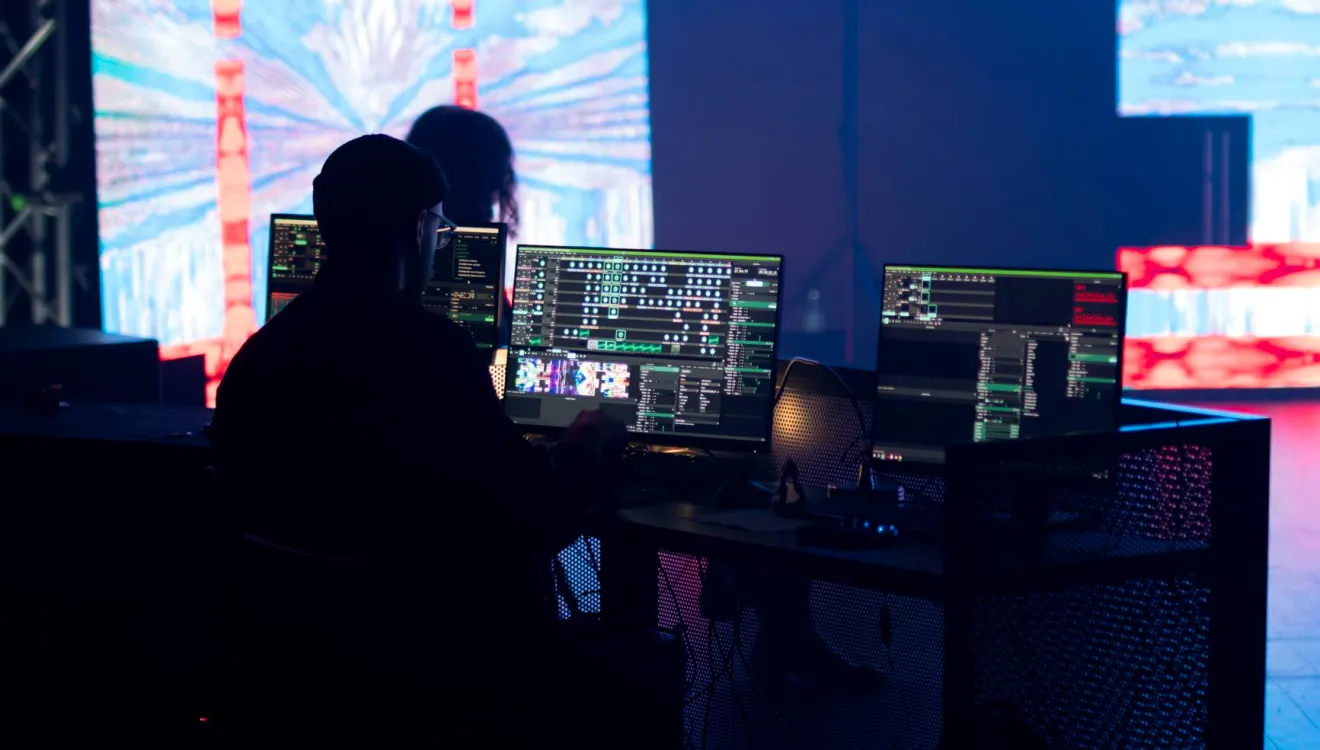
The core of the review is attendance. One of us sits in at rehearsal and stays through to transmission, ideally across more than one session, because a single good day hides as much as a bad one. We note how instructions travel, how long changes take, and where people wait for each other.

We pay attention to small things that crews have stopped noticing: a talkback channel that is always crowded, a camera shot called late because the director cannot see the next graphic, a lighting cue that has to be explained every time. None of these is dramatic, but together they set the pace of the whole shoot.

We stay quiet during live moments and keep our questions for afterwards. The aim is to see the programme as your crew experiences it, not to change it while we are there.

  • Attendance from rehearsal to transmission
  • Notes on waiting time and repeated explanations
  • Questions saved until the crew is free

What we look at beyond the gallery

A workflow is wider than the control room. We look at how cameras are shaded and matched, how audio feeds reach the mix, how lighting changes are called, and how the handover works between shifts or between studio and location. Each link is checked against the one before and after it.

Lighting is the area I watch most closely. A rig that suits one camera setup can make shading harder for another, and a late lighting change can ripple into audio and graphics. Seeing those knock-on effects is much easier from outside the team than from inside it.

We also check the unglamorous parts: how files are named, who owns the cue sheet, where the latest running order lives. Plenty of delays come from people working from different versions of the same document.

  • Camera matching and shading routine
  • Audio feed paths into the mix
  • Handover between shifts or locations

The written recommendations you keep

After the visits we write up what we found. The report sets out what works, what costs time, and what we suggest changing, in plain sentences with the reasoning beside each point. Recommendations are ordered so a team can start with the changes that need least effort and carry on from there.

We do not hand over a grand redesign unless your situation truly calls for one. Many of our suggestions are modest: a clearer call sequence, a revised camera plan, a shared checklist, a different order for rehearsal. We say plainly where a point is a judgement call rather than a certainty.

You receive the report in writing, and we are happy to talk it through with your producer and crew so that it does not sit unread in an inbox.

Questions to bring to the first call

You do not need to prepare much before ringing us. It helps to know which programmes or events you want reviewed, roughly how many crew work on them, and what prompted the idea: a run of late finishes, a new piece of equipment, a change of venue, or simply a feeling that things could run smoother.

If you have a recent running order or camera plan to hand, mention it, and we will ask for copies once the scope is agreed. Costs and timing are covered on our prices page, and we confirm everything in writing before work begins.

If the answer to your question is that a review would not help, we will say so. Sometimes a single conversation is enough to point a team in a useful direction.

  • Which programme or event to review
  • Roughly how many crew are involved
  • What made you consider a review now

A workflow review is attendance, listening and a clear written report, nothing more mysterious than that. We watch how your crew works from rehearsal to transmission, and we tell you in plain words what we saw and what we would change. If you are thinking about one for the winter schedule, ring the studio on 01743 580214 or use the contact page, and we will talk through what would suit your production.